Coal miners were mostly white men. "By the year 1913, of the more than 70,000 miners in the state, 14,506 of them were Negroes...32,612 were white Americans." (Reports of Mine Inspectors, 1913, pg. 15). Their wages, as of 1913, were 48 cents per ton of coal. The annual wage for a pick miner was $737.62.
Since most of the mines were located too far from towns, the coal companies built their own homes, Company Store, a church, and a post office. The miner’s family was to get what they needed by shopping at the Company Store. He was paid in not in real money but in money called "scrip" which could be spent only at the Company Store. The earliest coal scrip [tokens] dates back to about 1883. Each mine had its own scrip symbols on the tokens and one Company Store wouldn’t take scrip from a different company store, nor could you spend scrip in the city of Logan where the stores only took cash. The company own everything and deducted from the miner’s pay; electric, housing, food, furniture, doctor, and clothing. They would give the miner three dollars in cash every Wednesday which was deducted from his pay as well. If you needed cash before Wednesday, I recall a store in Logan that would give you seventy-five cent on a dollar for your scrip money.
 |
| Samples of script money |
The best way to describe Hutchinson company store is that it is like a super Wal-Mart, but a lot smaller, with gas pumps in front. The Orville Company Store was different inside - everything was lined up against the walls with a counter in front and you had to hand a list to counter person or ask and she would get you what you wanted. You couldn’t touch anything unless you brought it first. At Orville Company Store their post office was also inside the store. I had only been in two stores in both Orville and Hutchinson so maybe our store in Hutchinson was the one that was different. I do know that the Hutchinson store had the only post office that had it's own building away from the store. The post office was at the mouth of Macbeth hollow.
Each miner was given a card that he gave to his family to use in the store, for food or anything else that the family wanted to buy. You had to go to a window in the store, hand the card over to the office clerk, and tell them how much scrip that you wanted to draw from the miner’s pay. They would write that amount on the card, this way the miner could keep count of how much of his pay was being spent. It usually was how much that you were going to spend on food that day. This card was known as a scrip card and was about 4"x 8" long. Every payday the Company would issue a new card.
If the scrip card showed that the miner spent more than he made then it was carried over to the next two weeks pay. That's why the miner was always in debt to the Company Store. The Company Store would never refuse to give a miner scrip for food but they would limit him to three dollars scrip a day and still give him three dollars cash on Wednesday until he caught up to his pay. All this meant was he would get no paycheck on payday. But if the miner’s family didn’t use the scrip card at the Company Store, or draw out any of his pay, or used very little of his pay then he would get in his pay envelope cash instead of scrip. I've seen my Dad’s pay stub once: his salary was sixty dollars, don't know if that was for one week or two, which was a good pay check in the early fifty’s. I told my father that was a lot of money, Dad said that it was a shame that he got very little of the check on payday. More than one miner, would get next to no pay in his envelope because his family had taken all he had earned during the two-week pay period to live on. My Dad always manage to get a paycheck. He would start to holler at all of us if his pay was getting low, he made Mom stop buying at the company store.
The Government disallowed the Mines to pay the miners in scrip coins after 1960's. This meant was that for some miners, like my parent's who were always depended upon the coal company for everything, it was the first time they were responsible for their own housing, food, and any other bills. My parents didn't know how to handle their life after the mines closed; they didn't know how to pay bills until they were forced to learn much later after we moved to Ohio.
The coal companies built homes for their miners out of lumber with sheet-rock inside and wood siding on the outside, then painted them all white. The house had no indoor plumbing. Each home was set on cinder blocks about 2 1/2 feet off of the ground so that the water, which ran off of the mountain and into the creek, would not flood the homes. There were three different types of houses in a coal camp; two, three, or four rooms. Some homes had two floors with two rooms on the first floor and two on the second floor. Dehue had we called double homes which had a family living on each side of the house, this is close to the row homes in the cities today. In each house there was a fireplace in every room for heat except the kitchen which had a coal-cooking stove. In two of the rooms (bedrooms) there was a clothes closet, we called them presses.
The only reason you could tell which room was used for the kitchen was that it had a coal stove with table and chairs. Usually there was an upright kitchen cabinet, a bucket of water with a dipper, and a dishpan sitting on another table which was in a corner or up against the wall. In the latter part of the 1950’s some families had an electric stove and a refrigerator. We did have a refrigerator but it had nothing in it but the baby’s milk (my youngest sister's) and Mom's pop. Before the refrigerator we did have an ice box that set out on the front porch, the ice man would come once a week and put a block of ice in it for a price. The ice didn't cost much, however, I don't remember exactly how much. In the summer months we use to run behind the ice truck and grab the small pieces of ice or when he stopped the truck he would chip us all off a piece so that we would leave him alone and quite following him.
There wasn't always a house available for some of the miners and some of the camps had a boarding house where single men, who didn’t have families, lived. If you were a new hired you had to put your name on a list to get a house and wait for the next available home. The company would send men around every couple of years, usually when it got as black as coal dust, to spray paint your house white - all the Company homes were white.
The company took good care of their houses; if you had a broken window all the the miner had to do is to stop on his way to work, report it, and someone would be out to fix it that same day. The same thing went on for inside the house. The Company hired carpenters just to fix the homes.
Dehue school went from the first grade to the eight grade and took scrip from all the mines for lunches and school pictures. Lunches only cost fifteen cent then and when I first started school, at the age of six, Mom would give my sister and I the scrip card and tell us to stop at the Company Store as we pass by to take fifty cent out of Dad's pay for lunch and a snack to eat on the way to school. We would leave the card with the clerk and she would pick it up later. We always share with our friends who didn't have anything to eat but that soon stopped when we had moved up Macbeth hollow and didn't pass the company store anymore plus the mines slow down. I think I was about eight when I started getting lunch free. The mines was only working two or three days a week then and we were living on three dollars a day and we couldn't afford to buy our lunch at school. Dad didn't want us to take any money from his check so he would get a pay check.
If the miner was married and had a growing family, he probably was in debt with the Company Store to provide for them. To supplement for food, most married miners were allowed to clear and plant a garden on the side of the mountain if they wanted. My father planted one - not every spring, mind you. It was too much work to cut down trees and clear a space large enough for a garden.
The Company also built a club house where the miners gathered for their union meetings and vote. When election day came the miner’s would treat it like a holiday, everybody would gather at the club house while men would stand outside by the door and give every adult a pint of Old Kentucky whiskey while asking them to vote for their candidate. I heard Mom say once that she took the whiskey, went in, and voted for whom she wanted. No one was going to bribe her! By the end of the day everybody was happy and drunk.
At Hutchinson, the doctor’s office was located on the second floor of the clubhouse. The coal camps were independent of each other, some of the coal mines up the hollow had already close down and gone out of business, but there were still five mines up Rum Creek hollow open, I think Orville was the last mines to shut down. Each mine employed between two hundred and three hundred miners and they had their own company doctor. You were not allowed to go visit a doctor for help if your father didn’t work for those mines. The doctor would refuse to see you. The doctor’s office looked like a drugstore where he had all the drugs on hand that he would need to take care of anyone. If he needed to come your house, he carried a black bag full of drugs and needles to give you a shot. If a miner or a member of his immediate family took ill and died, the Company paid to have them bury on their land that they had set aside for a graveyard. Later I'll tell you about several times the doctor came to our house. It seems like he always came to see me. The miner would have the doctor expense deducted from his wages. Dad threaten me and told me that I had better stop going to see the doctor so much, I always stop to see the doctor when I wanted to get out of school that day. I didn't know that they were writing it down and my Dad had to pay for it, I thought it was free. I always had a good excuse; I'd cut my arm, or had an infection, or a sore throat - that was always a good one.
The miners walk to work, there was no place set aside for parking cars at the mine, if a miner did own a car they left it at home. My uncle Noah worked at Orville and lived in Logan, so he always drove to work and took a bath before he went home. If they didn’t live in the coal camp and had to drive to work they had to leave the car at the bathhouse. Not many of the miners lived outside of the coal camps, I only know of my uncle Noah and that was because my aunt Belva didn't like living in the coal camp. There was only about three cars at our end of Hutchinson and two telephones. Some of the men like to have cars so they could visit their families that lived off of the hollow or go shopping in Logan instead of at the company store. Our neighbor, JB, who lived four houses above us had a car and if we had an emergency Dad always ask him to take him where he had to go.
It was hard for a miner to get all the coal dust off of his skin, the only part about him that wasn’t cover in coal dust was the whites of his eyes and some miners would pay two dollars a week to take a shower before they went home. Counting our house there were two homes where miners could pay to take a bath in Macbeth that I knew about. I will get into how we got a bathhouse and running water in our house later as it's a long story. We never help the miner take a bath,only a miner's wife help him, or he was on his own. He would come at 6:30 am and change from his day clothes into his miner's uniform and then be back at 3:00 pm to take a shower. Before we had a bathhouse, my mother always had hot water ready for my father when he got home from the mines. She would have the tub sitting in the kitchen and when he came in she would help him take off his mining clothes and give him a bath.
The mines always blew a whistle at the start of work, at lunch time, and quitting time but if it blew any other time the families knew that there was trouble.
To get a clear picture of what a coal camp looks like picture the sea shore with the sand everywhere, well that is the same for a coal camp, except coal dust is everywhere and everything is black.
The summer time in a coal camp was loads of fun for kids. We played from morning to bedtime when our parents call us in to wash up with water which had been heated on the coal stove and we always listened to the radio shows before we went to bed. We never complained to our parents that there was nothing to do, we always found something to do nor did we ever find ourselves bored. I don’t ever remember seeing an overweight kid in camp. We played games or climbed the mountains; we exercise the fat right off of our bodies. The first thing that Mom would say in the morning, when she let us outside to play, was to watch out for the rattlesnakes. Snakes was the only life threatening thing for us but there was a lot of other mishaps that we could get into like falling into sink holes or breaking a bone from swinging on a grape vine from tree to tree. We couldn’t afford insect spray in those days, or there was none to buy because it hadn’t been invented yet, so Mom made her own insect repellent which worked just as good. She would set a rag on fire, smother it, and just let the rag smoke - that seemed to keep the bugs away.
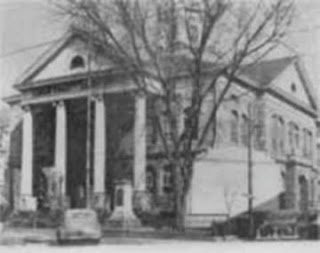 |
| Logan Court House burnt down in 1960. A more modern one was rebuilt. |
 |
My father drove a buggy train like this one to bring the
coal up out of the mines. He had a brakeman who rode the last car to help him
stop the train and keep it on the tracks. |